



Product Description
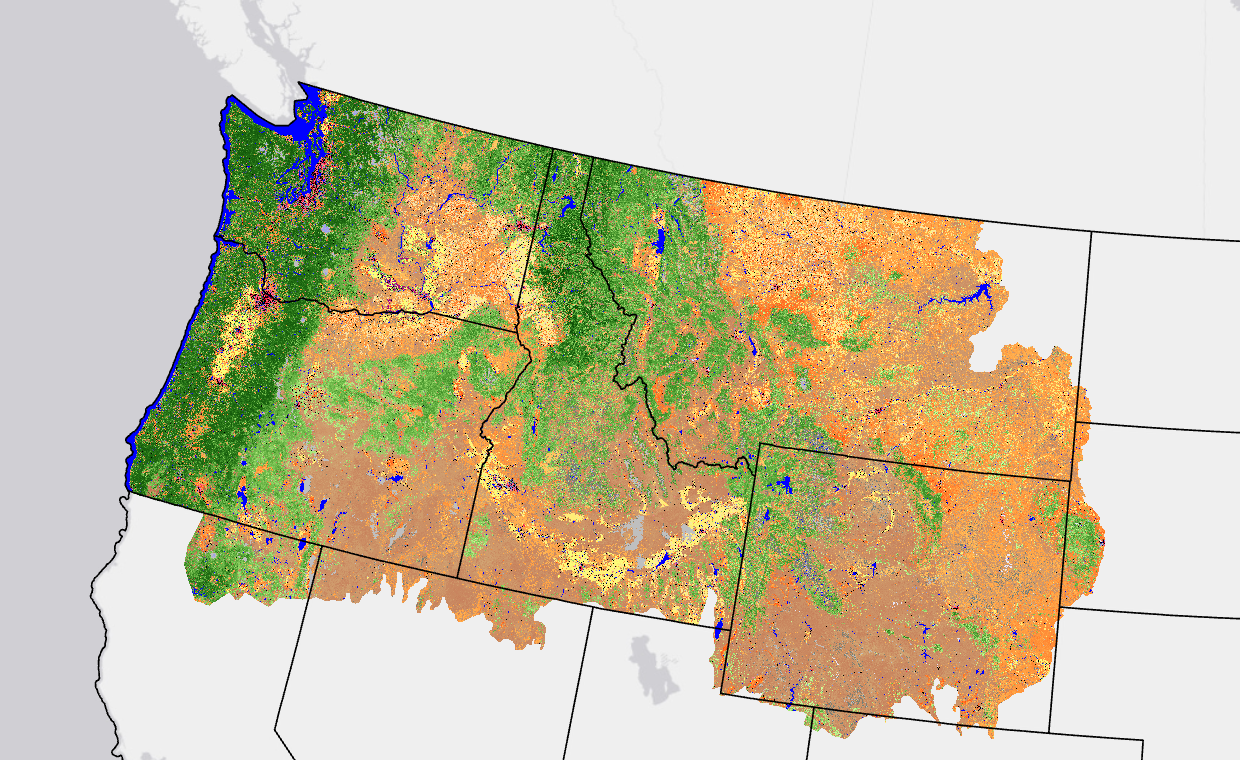 This page includes a general description of the product, please consult the schedule and version pages for information specific to each release.
LANDFIRE's (LF) Existing Vegetation Cover (EVC) represents the vertically projected percent cover of the live canopy layer for a 30-m cell.
EVC is generated separately for tree, shrub, and herbaceous cover lifeforms using training data and other geospatial layers. Percentage tree, shrub, and herbaceous canopy cover training data are generated using plot-level ground-based visual assessments and lidar observations.
- Once the training data are developed, relationships are then established separately for each lifeform between the training data and combination of Landsat and ancillary data. Each of the derived data layers (tree, shrub, herbaceous) has a potential range from 0-100 percent which are merged into a single composite EVC layer.
- Disturbance data is used to develop LF products for LANDFIRE Reference Database (LFRDB) plot filtering and to ensure that disturbances from recent years are included that were not visible in the source imagery.
LF 2016 Remap and beyond includes a 90-kilometer buffer along the 1,500 miles of the eastern and southern borders AK shares with Canada. Then with the LF 2020 update, and future updates, for the Conterminous United States (CONUS) a 90-kilometer buffer into Mexico is also included.
LF uses EVC in several subsequent layers, including the development of the fuel layers.
Existing Vegetation Cover Resources
| Key EVC Attributes | |
|---|---|
| VALUE | Existing vegetation cover (EVC) depicts percent canopy cover by life form |
| Developed-Upland Forest Shrub | 5 classes of Developed-Upland |
| Developed | 3 classes of Developed vegetation |
| Developed-Roads | 1 class of Developed Roads |
| NASS Crops | 6 classes of NASS crops |
| Tree Cover | % of Tree Cover |
| Shrub Cover | % of Shrub Cover |
| Herb Cover | % of Herb Cover |
| Count | number of pixels for the corresponding value |
| Classnames | Display attribute. EVC has a potential range of 0 - 100 percent canopy cover |
| Red | Red color value range 0 - 1 |
| Green | Green color value range 0 - 1 |
| Blue | Blue color value range 0 - 1 |
| Key EVC Attributes | |
|---|---|
| VALUE | Existing vegetation cover (EVC) depicts percent canopy cover by life form |
| Developed-Upland Forest Shrub | 5 classes of Developed-Upland |
| Developed | 3 classes of Developed vegetation |
| Developed-Roads | 1 class of Developed Roads |
| NASS Crops | 6 classes of NASS crops |
| Tree Cover | % of Tree Cover |
| Shrub Cover | % of Shrub Cover |
| Herb Cover | % of Herb Cover |
| Count | number of pixels for the corresponding value |
| Classnames | Display attribute. EVC has a potential range of 0 - 100 percent canopy cover |
| Red | Red color value range 0 - 1 |
| Green | Green color value range 0 - 1 |
| Blue | Blue color value range 0 - 1 |
LF Definitions, Quality, and Standards - provides information about contributors, metadata and data standards, data creation, and data testing. This document also provides details about our general data release process.
LF Dictionary - a “one-stop shop” general resource that provides information about products, Attribute Data Dictionaries (ADDs), data and metadata, and terms.
LF Version Comparison Table - view the version history for each individual product.
LF Naming Conventions - understanding the version number
Detailed annual updates to vegetation maps for the US using machine learning [pptx]
LF Definitions, Quality, and Standards - provides information about contributors, metadata and data standards, data creation, and data testing. This document also provides details about our general data release process.
LF Dictionary - a “one-stop shop” general resource that provides information about products, Attribute Data Dictionaries (ADDs), data and metadata, and terms.
LF Version Comparison Table - view the version history for each individual product.
LF Naming Conventions - understanding the version number
Detailed annual updates to vegetation maps for the US using machine learning [pptx]