The website will be offline from Wednesday the 27th of May 2026 at 8:00 AM to Wednesday the 27th of May 2026 at 12:00 PM. We apologize for any inconvenience this may cause.

Product Description

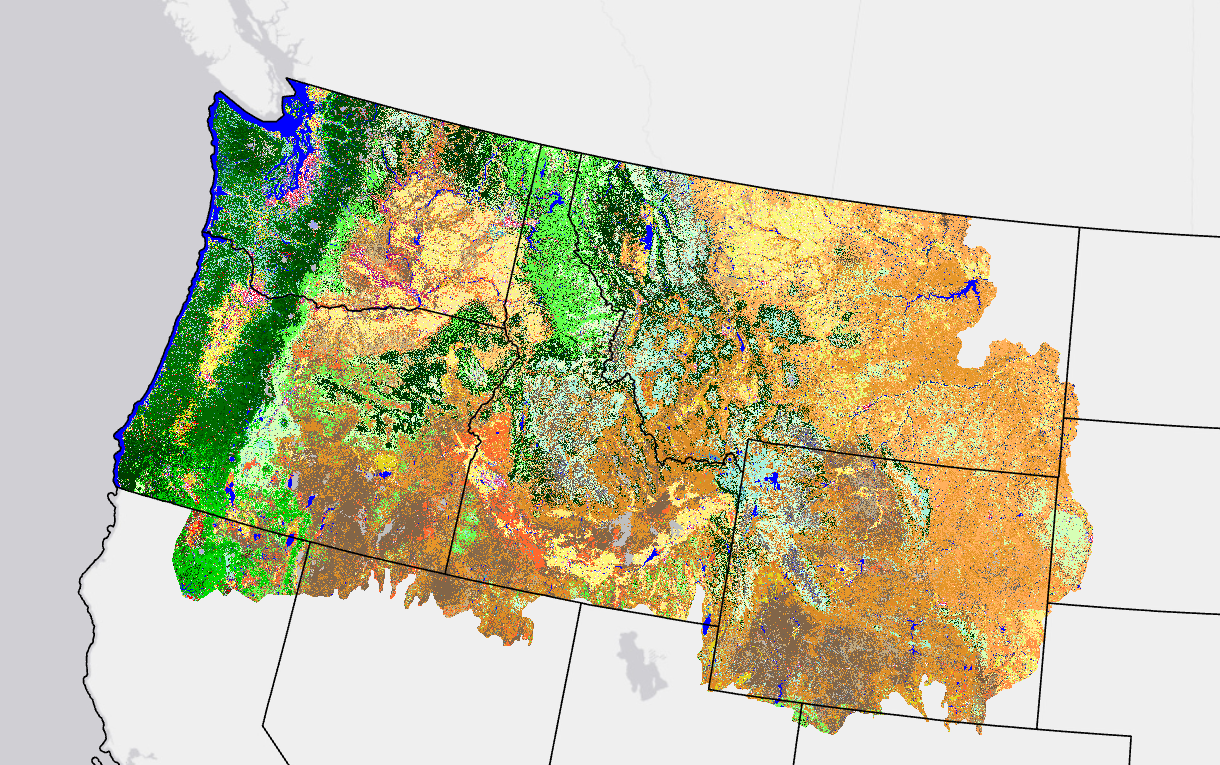
Image showing fuel vegetation type over the upper NW corner of the U.S.This page includes a general description of the product, please consult the schedule and version pages for information specific to each release.

The LANDFIRE (LF) fuels vegetation products describe the elements of fuels vegetation for each LF vegetation production unit. Fuel Vegetation Type (FVT) represents a modified version of Existing Vegetation Type (EVT). FVT more accurately leverages fuel transition assignments related to disturbed areas by re-establishing pre-disturbance vegetation. Linking disturbed areas to pre-disturbance EVTs allows fuel model transition assignments to properly align with logic developed from Fuels Calibration Workshops, giving more accurate representations during fire behavior analysis.

FVT was developed using the full suite of LF vegetation releases and the most recent 10 years of Annual Disturbance products. The FVT product is then evaluated through a series of QA/QC measures ensuring lifeform of the vegetation type assignment matches the lifeform of associated FVT layers.

LF 2016 Remap and beyond includes a 90-kilometer buffer along the 1,500 miles of the eastern and southern borders AK shares with Canada. Then with the LF 2020 update, and future updates, for the Conterminous United States (CONUS) a 90-kilometer buffer into Mexico is also included.

LF uses FVT in the development of the fuel products.


Fuel Vegetation Type Resources

Product Description

This page includes a general description of the product, please consult the schedule and version pages for information specific to each release.

The LANDFIRE (LF) fuels vegetation products describe the elements of fuels vegetation for each LF vegetation production unit. This product represents pre-disturbance fuels where disturbance has occurred over the last 10 years. Fuel Vegetation Height (FVH) represents a modified version of Existing Vegetation Height (EVH). LF 2016 Remap EVH is mapped as continuous estimates of canopy height for tree, shrub, and herbaceous lifeforms. To translate continuous EVH values into fuel model assignments, EVH values were binned to correspond with the bins for previous LF versions.

FVH was developed using the full suite of LF vegetation releases and the most recent ten years of disturbance data. FVH more accurately leverages fuel transition assignments related to disturbed areas to properly align with logic developed from Fuels Calibration Workshops.

LF 2016 Remap and beyond includes a 90-kilometer buffer along the 1,500 miles of the eastern and southern borders AK shares with Canada. Then with the LF 2020 update, and future updates, for the Conterminous United States (CONUS) a 90-kilometer buffer into Mexico is also included.

Modeling Dynamic Fuels with an Index System (MoD-FIS)- refined FVH classification based upon current estimates of FVH from Landsat imagery for the current growing season.

LF uses FVH in the development of the fuel products.


Image showing fuel vegetation height in the upper NW corner of the U.S.
FAQs

No, FVH represents pre-disturbance fuels before they are run through the LFTFC tools. For current fuels, look at CC, CH, CBH, CBD, and FBFM40 and FBFM13.

Fuel Vegetation Height Resources

Product Description

This page includes a general description of the product, please consult the schedule and version pages for information specific to each release.

The LANDFIRE (LF) fuels vegetation products describe the elements of fuels vegetation for each LF vegetation production unit. This product represents pre-disturbance fuels where disturbance has occurred over the last 10 years. Fuel Vegetation Cover (FVC) represents a modified version of Existing Vegetation Cover (EVC). LF 2016 Remap EVC is mapped as continuous estimates of canopy cover for tree, shrub, and herbaceous lifeforms with a potential range from 0-100 percent. To translate continuous EVC values into fuel model assignments, EVC values were binned to correspond with the bins for previous LF versions.

FVC was developed using the full suite of LF vegetation releases and the most recent ten years of disturbance data. FVC more accurately leverages fuel transition assignments related to disturbed areas to properly align with logic developed from Fuels Calibration Workshops.

LF 2016 Remap and beyond includes a 90-kilometer buffer along the 1,500 miles of the eastern and southern borders AK shares with Canada. Then with the LF 2020 update, and future updates, for the Conterminous United States (CONUS) a 90-kilometer buffer into Mexico is also included.

Modeling Dynamic Fuels with an Index System (MoD-FIS)- refined FVC classification based upon current estimates of FVC from Landsat imagery for the current growing season.

LF uses FVC in the development of the fuel products.


Image showing fuel vegetation cover in the upper NW corner of the U.S.
FAQs

No, FVC represents pre-disturbance fuels before they are run through the LFTFC tools. For current fuels, look at CC, CH, CBH, CBD, and FBFM40 and FBFM13.

Fuel Vegetation Cover Resources

Product Description

Image showing canopy base height colors over the upper NW corner of the U.S.This page includes a general description of the product, please consult the schedule and version pages for information specific to each release.

LANDFIRE's (LF) Forest Canopy Base Height (CBH) describes the average height from the ground to a forest stand's canopy bottom. Specifically, it is the lowest height in a stand at which there is enough forest canopy fuel to propagate fire vertically into the canopy. CBH unit measurements are meters * 10. These products are provided for forested areas only. Canopy Base Height (CBH) and Canopy Bulk Density (CBD) are calculated using the program FuelCalc designed by Elizabeth Reinhardt of the Missoula Fire Sciences Laboratory. This program ingests plot data (including species, diameter at breast height (DBH), height, height to live crown, canopy cover, and trees per acres) and computes CBD using species-specific allometric relationships. CBH is assumed to equal the height at which CBD becomes 0.012 kg m3.

CBH first incorporated Annual Disturbance products during LF 2008 production. The introduction of this information allowed for informed changes to the assigned CBH from disturbance type, severity, and time since the disturbance.

LF 2016 Remap and beyond includes a 90-kilometer buffer along the 1,500 miles of the eastern and southern borders AK shares with Canada. Then with the LF 2020 update, and future updates, for the Conterminous United States (CONUS) a 90-kilometer buffer into Mexico is also included.

CBH provides information for fire behavior models to determine areas in which a surface fire is likely to transition to a crown fire.


Forest Canopy Base Height Resources

Product Description

Image showing canopy bulk density in the upper corner of the U.S.This page includes a general description of the product, please consult the schedule and version pages for information specific to each release.

LANDFIRE's (LF) Forest Canopy Bulk Density (CBD) describes the density of available canopy fuel in a stand. It is defined as the mass of available canopy fuel per canopy volume unit. CBD unit measurements are kg m3 * 100. These products are provided for forested areas only. Canopy Base Height (CBH) and Canopy Bulk Density (CBD) are calculated using the program FuelCalc designed by Elizabeth Reinhardt of the Missoula Fire Sciences Laboratory. This program ingests plot data (including species, diameter at breast height (DBH), height, height to live crown, canopy cover, and trees per acres) and computes CBD using species-specific allometric relationships. CBH is assumed to equal the height at which CBD becomes 0.012 kg m3.

CBD first incorporated Annual Disturbance products during LF 2008 production. The introduction of this information allowed for informed changes to the assigned CBD from disturbance type, severity, and time since the disturbance.

LF 2016 Remap and beyond includes a 90-kilometer buffer along the 1,500 miles of the eastern and southern borders AK shares with Canada. Then with the LF 2020 update, and future updates, for the Conterminous United States (CONUS) a 90-kilometer buffer into Mexico is also included.

CBD supplies information for fire behavior models, such as FARSITE, to determine the initiation and spread characteristics of crown fires across landscapes.


Forest Canopy Bulk Density Resources

Product Description

Image showing canopy height over the upper NW corner of the U.S.This page includes a general description of the product, please consult the schedule and version pages for information specific to each release.

LANDFIRE's (LF) Forest Canopy Height (CH) describes the average height of the top of the vegetated canopy. CH measurement units are meters * 10 and extracted from Existing Vegetation Height (EVH). CH is assigned the midpoint of the EVH forested classes at non-disturbed locations. These products are provided for forested areas only.

CH first incorporated Annual Disturbance products during LF 2008 production. The introduction of this information allowed for informed changes to the assigned CH from disturbance type, severity, and time since the disturbance.

LF 2016 Remap and beyond includes a 90-kilometer buffer along the 1,500 miles of the eastern and southern borders AK shares with Canada. Then with the LF 2020 update, and future updates, for the Conterminous United States (CONUS) a 90-kilometer buffer into Mexico is also included.

Used in the calculation of Canopy Bulk Density and Canopy Base Height, CH supplies information to fire behavior models to provide input in the spotting model and calculate wind reductions.


Forest Canopy Height Resources

Product Description

Image showing canopy cover in the upper NW corner of the U.S.This page includes a general description of the product, please consult the schedule and version pages for information specific to each release.

LANDFIRE's (LF) Forest Canopy Cover (CC) describes the percent cover of the tree canopy in a stand. Specifically, canopy cover describes the vertical projection of the tree canopy onto an imaginary horizontal surface representing the ground's surface. At non-disturbed locations, CC is assigned the midpoint of the Existing Vegetation Cover (EVC) forested classes. These products are provided for forested areas only.

CC first incorporated Annual Disturbance products during LF 2008 production. The introduction of this information allowed for informed changes to the assigned CC from disturbance type, severity, and time since the disturbance.

LF 2016 Remap and beyond includes a 90-kilometer buffer along the 1,500 miles of the eastern and southern borders AK shares with Canada. Then with the LF 2020 update, and future updates, for the Conterminous United States (CONUS) a 90-kilometer buffer into Mexico is also included.

Used in the calculation of Canopy Bulk Density and Canopy Base Height, CC supplies information to fire behavior models to determine the probability of crown fire initiation, provide input in the spotting model, calculate wind reductions, and calculate fuel moisture conditioning.


Forest Canopy Cover Resources

Product Description

Image showing fuel disturbance in the upper NW corner of the U.S. This page includes a general description of the product, please consult the schedule and version pages for information specific to each release. 

LANDFIRE (LF) disturbance products are developed to provide temporal and spatial information related to landscape change. Fuel Disturbance (FDist) uses the latest 10 years of Annual Disturbance products representing disturbance year and original disturbance code. FDist was a refinement of Vegetation Disturbance (VDist) in LF 1.x products and is a refinement of Historical Disturbance (HDist) in LF 2016 Remap to more accurately represent disturbance scenarios within the fuels environment. FDist development involves a comprehensive review of disturbance attributes. 

LF 2016 Remap and beyond includes a 90-kilometer buffer along the 1,500 miles of the eastern and southern borders AK shares with Canada. Then with the LF 2020 update, and future updates, for the Conterminous United States (CONUS) a 90-kilometer buffer into Mexico is also included. 

LF uses FDist in the development of Fuels products.


Fuel Disturbance Resources

Product Description

Image showing colors for FCCS in the upper NW corner of the U.S.This page includes a general description of the product, please consult the schedule and version pages for information specific to each release.

Fuel Characteristic Classification System (FCCS) defines a fuelbed as the inherent physical characteristics of fuel that contribute to fire behavior and effects (Riccardi and others 2007). A fuelbed can represent any scale or precision of interest. In FCCS, fuelbeds represent the structure and composition of wildland fuels and can accommodate a wide range of fuel characteristics in six horizontal fuel layers called strata (Ottmar and others 2007).

FCCS summarizes and classifies wildland fuel characteristics and can also be used to predict surface fire behavior, crown fire potential and available fuel for estimating consumption, fire effects, and emissions.

  • FCCS reference fuelbeds represent fuels throughout much of North America and were compiled from published literature, fuels photo series, other fuels data sets and expert opinion.
  • The LANDFIRE (LF) fuels team collaborated with the Fire and Environmental Research Applications (FERA) team of the U.S. Forest Service Pacific Northwest Research Station on the FCCS product.
  • FCCS fuel beds have been mapped in LF and are preloaded in the Fuel and Fire Tools (FFT) application.

The fundamental component of the FCCS, the fuelbed, is the mapping unit in the FCCS. The LF FCCS is delivered with attributes summarized from the FCCS calculator for each fuelbed, including name and fuel loading information in tons per acre. This information can be used for fire behavior and fire effects estimations.

Consume Input Tables are formatted for use in the Consume 4.2 calculator embedded in the FFT software. Fuel loading units are in tons per acre and can be used in the command line version of Consume. This table can be used in conjunction with the LF FCCS layers in a mapping program, and be cross walked via the FCCSID in column B.

First Order Fire Effects Model (FOFEM) Input Tables provide fuel loading values summarized for use in the general FOFEM calculator. The file is not formatted for use in the FOFEM batch feature in the program. Fuel loading units are tons per acre and with additional fuel moisture and site descriptors this file can be adapted to work in the FOFEM batch function. This table can be used in conjunction with the LF FCCS layers in a mapping program, and be cross walked via the FCCSID in column B.

LF 2016 Remap and beyond includes a 90-kilometer buffer along the 1,500 miles of the eastern and southern borders AK shares with Canada. Then with the LF 2020 update, and future updates, for the Conterminous United States (CONUS) a 90-kilometer buffer into Mexico is also included.

FCCS Disturbance Transition Database

Notice

When using Microsoft Access to view a database downloaded from the internet, users may see a Security Risk Error that prevents the database from opening. As of September 2024, all Microsoft products block macros by default to prevent potential malicious activity. To unblock macros on trusted files, do the following:

  • Open the folder in which the file is saved
  • Right-click the file and select Properties
  • Under the General tab, select the checkbox next to Unblock
  • Click OK

To read more about Microsoft and blocked macros, click here.


Fuel Characteristic Classification System Fuelbeds Resources

Product Description

Image of Alaska showing CFFDRS colorsThis page includes a general description of the product, please consult the schedule and version pages for information specific to each release.

Canadian Forest Fire Danger Rating System (CFFDRS) depicts fuel types "as an identifiable association of fuel elements of distinctive species, form, size, arrangement, and continuity that will exhibit characteristic fire behavior under defined burning conditions". The CFFDRS arranges fuel types into five major groups with 16 discrete fuel types that are qualitatively distinguished by variations in their forest floor and organic layer, surface, and ladder fuels, and stand structure and composition.

The CFFDRS assignments for Alaska were made by fire behavior and fuels experts based on Existing Vegetation Type descriptions and representative photos.

LF 2016 Remap and beyond includes a 90-kilometer buffer along the 1,500 miles of the eastern and southern borders AK shares with Canada. Then with the LF 2020 update, and future updates, for the Conterminous United States (CONUS) a 90-kilometer buffer into Mexico is also included.

The CFFDRS product is currently produced for Alaska only.


Canadian Forest Fire Danger Rating System Resources